


Female cyclists accused of ‘faking larger bra size’ at Tour de France Femmes
Female cyclists accused of ‘faking larger bra size’ at Tour de France Femmes

Tom CaryTue, August 4, 2026 at 7:00 AM UTC
0

The time trial takes place in Côte d’Or - Shutterstock
A row has broken out at the Tour de France Femmes following allegations that some riders are artificially exaggerating their bust size to gain a “bra booster” aerodynamic advantage for Tuesday’s time trial.
According to WielerFlits, a leading cycling news platform in the Netherlands and Belgium, “several” women’s WorldTour teams have raised concerns that riders are padding their bras to “fake” a larger cup size.
What is ‘bra boosting’ and how does it work?
Referred to as ‘chest fairing’, increasing the surface area of the chest can change the airflow around the cyclist during the time trial and thus create a measurable benefit over the course of multiple kilometres.
Bert Blocken, professor of aerodynamics at Heriot-Watt University in Scotland and LUT in Finland, who has produced studies on the subject, told Telegraph Sport that he had been sent photographs that “seemed to suggest that there are indeed some objects that some female riders stick behind their shirt”.
Prof Blocken added that “it was definitely a concern with the men’s races in 2023 and 2024” which was then addressed in a scientific article he had published. Prof Blocken said that he had also talked directly to the UCI about the issues.
Entitled “Analysis of chest-fairings in time trial cycling” the scientific review found that chest fairing can give a 3.6 per cent drag reduction and concluded that “time gains by chest-fairing can decide who wins or loses a time trial”.
Prof Blocken’s article defines chest-fairing as when “some cyclists in triathlon and road cycling competitions have been riding with an object stuck between their chest and their shirt, attempting to reduce aerodynamic drag”. The most excessive examples had previously occurred in triathlon, with the use of water bottles. Prof Blocken wrote that “cyclists, cycling teams and cycling product manufacturers are constantly looking for aerodynamic improvements that can withstand the scrutiny of the International Cycling Union (UCI)”.
Prof Blocken stressed that he does not follow women’s cycling closely but said that he had been shown the photographs by a journalist from WielerFlits.
Both the UCI and the Tour de France Femmes have been approached for comment before Tuesday’s time trial.
The teams WielerFlits spoke to anonymously believe that the UCI should have a female official check the riders immediately after the time trial in a closed tent to ensure they are not concealing anything in their bra or under their aero clothing.
Why would having a larger bust help in time trialling?
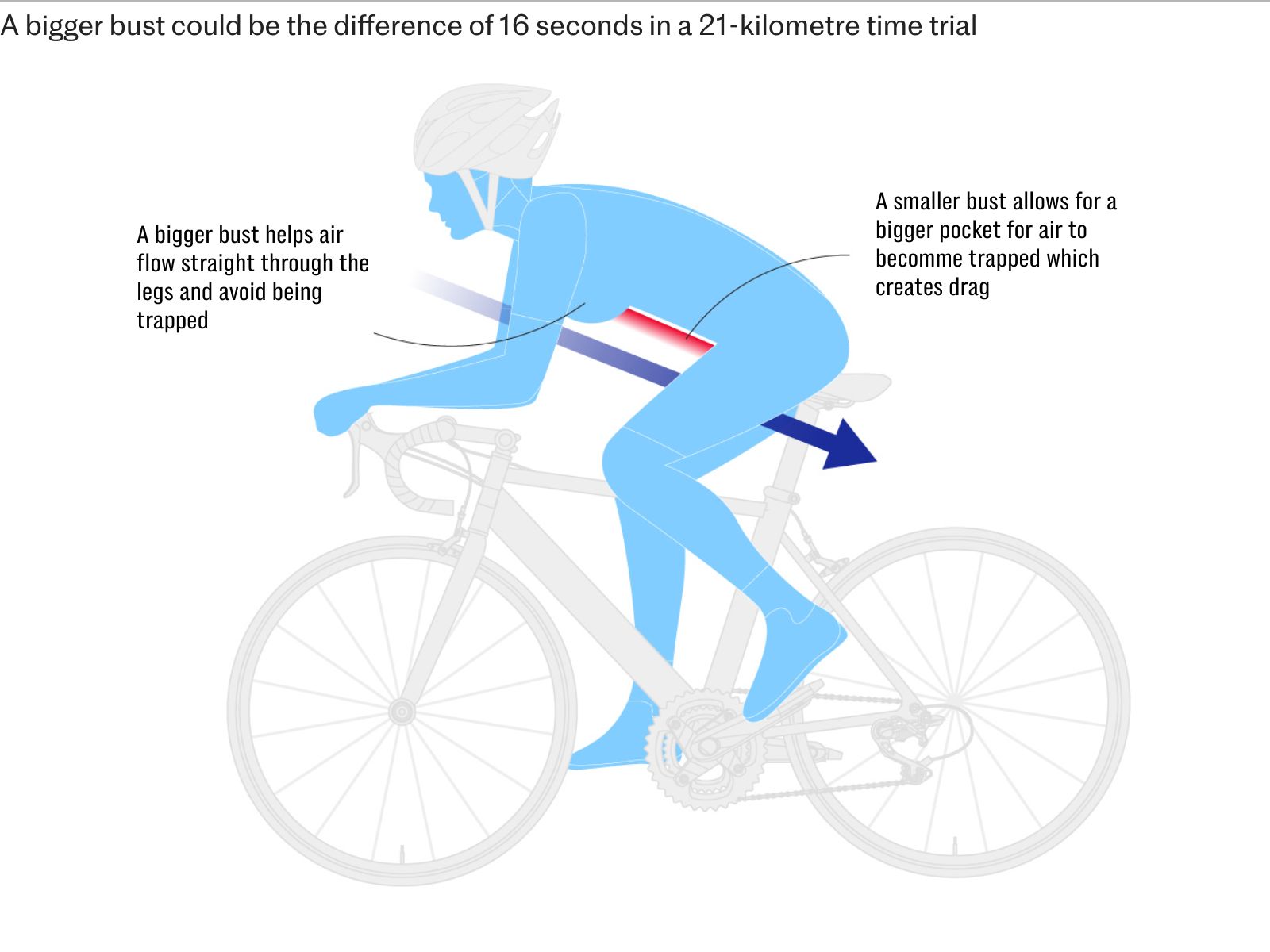
It might sound counterintuitive that a ‘larger’ skinsuit would help to produce an aerodynamic advantage. Would not wrinkles or loose, baggy fabric slow a rider down? Well, yes they would. But the theory behind artificially inflating your bust is that by altering the shape of the chest, a rider can create a better airflow underneath a perfectly tight skinsuit.
In time trials, riders adopt a tucked position with their forearms close together over their bars. This creates a pocket or “valley” between the helmet, shoulders and chest. Air flowing into that depression can separate and become turbulent, increasing drag.
By adding carefully shaped padding to the chest, the front of the rider becomes rounder and smoother, acting like a fairing that guides the airflow cleanly around the body.
Prof Blocken’s thesis, published on ScienceDirect two years ago, concluded that riders could achieve a reduction in air resistance of up to 3.6 per cent when using an object in the optimal shape that covers the chest. This translates into a time saving of at least 0.78 seconds per kilometre. Across Tuesday’s 21-kilometre individual time trial, that could in theory equate to more than a 16-second difference in time.
Advertisement
Why is ‘chest-fairing’ controversial?
Artificially altering clothing is prohibited by the International Cycling Union (UCI). If a rider is caught during or after a race and therefore in violation of Article 1.3.033 of the UCI’s regulations, they could face immediate disqualification and a fine ranging from 200 Swiss francs (£184) to 1,000 (£918), or potentially higher for more serious or intentional rule breaches.
Tour de France Femmes organisers announced on Monday night that they will attempt to prevent any scandal from arising by requiring riders to report for bike and outfit checks at least 10 minutes before the start of Tuesday’s fourth stage. In their stage three jury report, organisers added: “Pre-checks on riders’ equipment (race and spare bikes, their respective accessories and devices) will be carried out by the two appointed UCI Technical Commissaires, Sandro Coccioni and Alexandre Nouhaud, with the support of Magali Barbe for the check of the jersey at the start area.
“Particular attention will be paid to compliance with article 1.3.032 of the UCI regulations, including non-essential elements and clothing or other items/accessories worn by a rider (including but not limited to helmets, glasses, shoes or in-race communication devices) which could modify riders’ morphology.”
However, in practice, there is little enforcement of this rule.
The controversy has strong echoes of the “Penis-gate” row which erupted at the Winter Olympics earlier this year. That came after three senior members of Norway’s ski jumping staff were banned following a routine equipment check on two Norwegian jumpers after their home world championships in Trondheim.
The elastic material around the crotch area was more rigid than officials expected and, once the various layers were opened up, reinforced thread was found woven into the suits, which had also increased the surface area.
Accusations of skulduggery peaked with separate claims in German tabloid Bild that some leading ski jumpers had been enlarging their penises by injecting hyaluronic acid.
It is a similar story at the Tour de France Femmes – the nine-day race which is the fifth edition of the women’s event in its current format – with suspicions that some riders are trying to gain an unfair advantage in the time trial by exaggerating their bust size.
Meanwhile, Stage 3 of the Tour de France Femmes was won by Norwegian national champion Sigrid Haugset who managed to break away before holding on to become the first Norwegian stage winner in the history of the Tour de France Femmes. Haugset moved into the leader’s yellow jersey as a result.
Elsewhere, newly crowned five-time Tour de France champion Tadej Pogacar has announced he will race in the Vuelta a España, which begins later this month, in an attempt to win all three of cycling’s grand tours.
The 27-year-old Slovenian, who won the 2024 Giro d’Italia by nearly 10 minutes and would become only the ninth rider to win all three Grand Tours in history should he triumph in Spain, said he was excited to go back to the race, which he finished third in 2019.
“I’m excited to say I’m going back to La Vuelta,” said Pogacar. “It was my first ever Grand Tour back in 2019 and an amazing experience. Spain is a country I love to visit and race in, and I think the time is right to go back.
“The motivation is high to finish off the year in a good way and the Vuelta will be a big target. The team is strong and we hope to do good things.”
This year’s race begins in Monaco on Aug 22 and finishes in Granada on Sept 13.
Source: “AOL Sports”
